Entry point
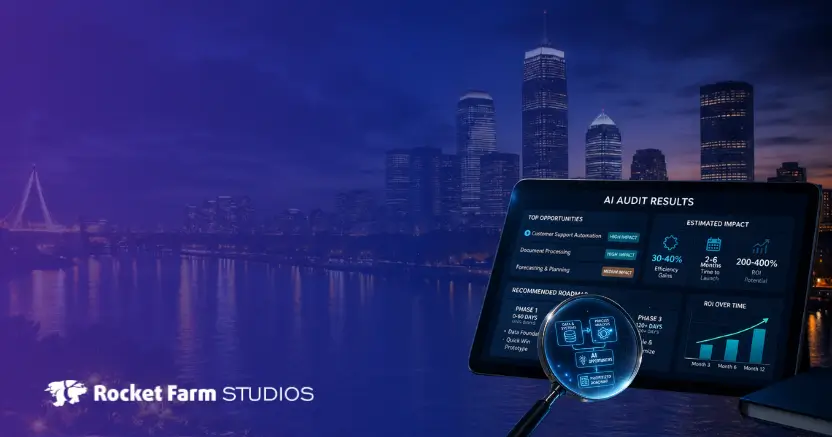
AI Audit
— Where should AI fit?
Know where AI actually fits before you spend a dollar building it. Opportunity map, ROI model, and a prioritized roadmap in your hands.
Whether you’re validating an idea, scaling an AI product, or automating operations — find your path here.
— Where should AI fit?
Know where AI actually fits before you spend a dollar building it. Opportunity map, ROI model, and a prioritized roadmap in your hands.
— Is it worth betting on?
Three weeks, one working prototype, one clear go / no-go decision with evidence behind it. Kill bad ideas fast, accelerate good ones.
— How do we ship it?
From prototype to production: architecture, design, engineering, and launch readiness — with weekly demos and gated checkpoints.
— What can we streamline?
Take complex manual workflows and make them faster, cheaper, more reliable. Rules engines, document processing, and integration pipelines.
— What can we make autonomous?
Beyond demos. Production agents that observe, plan, and act on real workflows — with safety, monitoring, and orchestration baked in.
— How do we win in market, after launch?
Most agencies ship and disappear. We stay on as a retained pod — product, engineering, growth, and data on one weekly drumbeat until the metrics actually move.
One studio, one senior team. The starting line just depends on where you are today.
Strategy, design, and engineering under one roof. The same partners who scope your AI product ship it — through GA and beyond.
Vector + hybrid search, re-ranking, citations.
Tool-use, planning, multi-step orchestration.
LoRA, full FT, distillation, custom evals.
Vision, speech, document, structured output.
Core ML, Gemini Nano, quantization, ANE.
Golden sets, LLM-as-judge, red teaming.
Routing, caching, batching, cost ceilings.
Tracing, drift, hallucination tracking.
A typical engagement, plotted week by week. Tasks overlap — strategy doesn’t pause when engineering starts.
Four shipped products. Four outcomes worth talking about. What could yours look like?

Built the mobile experience that put the live outdoor rowing reality on the kitchen wall — real-time metrics, hardware integration, live streaming. Six months to ship.

Interactive sheet music app for one of the most photogenic brands on earth. Built once, scaled globally, in active use today.

Clinical insights platform for the world’s largest physician network. Built for the regulated markets where the wrong UX is a compliance failure.

Three ad-tech and analytics SDKs shipped in three months. Motally acquired by Nokia. AdMeld acquired by Google in 2011 for a reported $400M.
Field notes from the studio — what we’re learning about AI products, agent UX, and the messy reality of shipping software in 2026.
Award-winning iOS and Android app development from a Boston AI development company. iPhone, Android, web, and AI — built by the same senior team.
Boston iOS development for iPhone and iPad — built for the App Store.
Android developers in Boston shipping native, Kotlin-first apps for Google Play.
High-performance iOS and Android apps built for scale.
Dynamic, scalable web solutions for growth.
Smarter, faster, more responsive AI — built into the product.
Secure, adaptable cloud architectures that hold up.
Bridging physical and digital for real-world impact.
ASO descriptions and search engine optimization that earns ranks.
Turn MVPs into market leaders with data-driven growth.
Targeted campaigns for installs, engagement, and retention.
The questions buyers ask before booking a call with a Boston AI development company. Honest answers below.
An AI app development firm designs and launches AI-native products across iOS, Android, and web platforms with integrated retrieval systems, language model reasoning, autonomous agents, and vision capabilities from project initiation. Rocket Farm Studios has operated since 2008, with clients raising over $1B collectively and 100+ completed products spanning mobile, web, and AI domains.
A three-week prototype sprint typically ranges $15–25K. A complete AI-native product build spanning 12–16 weeks across both mobile platforms and AI systems falls between $250–500K. Enterprise consulting and agent development for regulated sectors costs more. Initial discovery discussions are complimentary with estimates provided within 48 hours.
AI app development means the app’s core value depends on AI — LLM-driven workflows, RAG search over your data, agentic systems, or computer vision. If removing AI leaves the product functional, it’s merely a feature. Boston AI development teams manage model selection, evaluation frameworks, system monitoring, and expense control — elements traditional mobile development omits.
Yes, with iOS development since 2009 and Android development since 2010. Native Swift/SwiftUI for Apple devices, native Kotlin/Jetpack Compose for Android. Cross-platform solutions (React Native or Flutter) when appropriate. Most projects launch both platforms — sometimes together, sometimes sequentially.
RAG (Retrieval-Augmented Generation) means your AI retrieves real information from your data before answering — instead of relying on the model’s training data and hallucinating. Production RAG development requires vector storage, embedding approaches, evaluation harnesses, and monitoring. Systems we build retrieve correct answers with 95%+ accuracy and sub-second response times.
Yes — agent development represents a core competency. Multi-step tool-using agents, customized workflows, and orchestration layers that complete actual work rather than simulating capability. Implementations include monitoring, evaluation, audit logging, and human oversight where required.
App Store Optimization improves app ranking and conversion within both Apple and Google storefronts through description optimization, keyword research, screenshot testing, and engagement prompts. ASO integrates throughout our development engagements rather than functioning as a separate outsourced service.
Yes. Projects include HIPAA-compliant AI for Sermo (1.3M verified physicians globally) and medical applications like Eyebot (autonomous examination kiosks). Healthcare-focused development operates within HIPAA, and protected health information frameworks.
Yes — a dedicated practice focuses on fortifying prototypes developed with AI coding tools. Services include infrastructure review, security assessment, performance scaling, and production-grade engineering implementation. Teams maintain prototype momentum while adding enterprise-level foundations.
Boston maintains deep roots as a software engineering hub since the 1970s, anchored by MIT, Harvard, local AI research institutions, and consumer/enterprise product ecosystems. Rocket Farm Studios operates from Needham, Massachusetts since 2008 with established connections throughout Boston’s AI consulting, mobile, iOS, and Android development communities while serving global clients.